Third-party logistics is now a market worth roughly $1.5 trillion globally, growing at double-digit rates. But "3PL" gets used loosely, and the way these companies actually operate (and make money) is less obvious than the acronym suggests. This guide breaks down what a 3PL business is, how the model works, the main types, where the revenue comes from, and what it takes to start a 3PL company from scratch.
TL;DR
- A 3PL runs warehousing, fulfillment, and transportation without ever owning the goods.
- Brands hand off the operations they would rather not run in-house.
- There are several 3PL types: asset-based, non-asset-based, and asset-light, each with different trade-offs.
- Revenue comes from storage, pick and pack, freight margins, value-added services, and technology fees.
- Running a 3PL business goes beyond storage space: licensing, technology, and clients are some aspects of what a 3PL reality is about.
- Client acquisition: filling that capacity is as much a logistics marketing problem as an operational one.
What Is a 3PL Business?
A 3PL business (third-party logistics) is a company that runs all or part of another company's logistics workflows. The client manufactures or buys products; the 3PL stores that inventory, processes orders, picks and packs them, arranges shipping, and often handles returns; all without ever taking ownership of the goods.
In industry terms, logistics management is the part of supply chain management that controls the flow and storage of goods between origin and consumption. A 3PL takes that function off the client's plate.
The brand keeps control of the product, marketing, and growth, while the 3PL absorbs the warehousing, labor, and freight complexity.
How the 3PL Business Model Works - 5 Steps
At an operational level, the model follows a predictable flow:
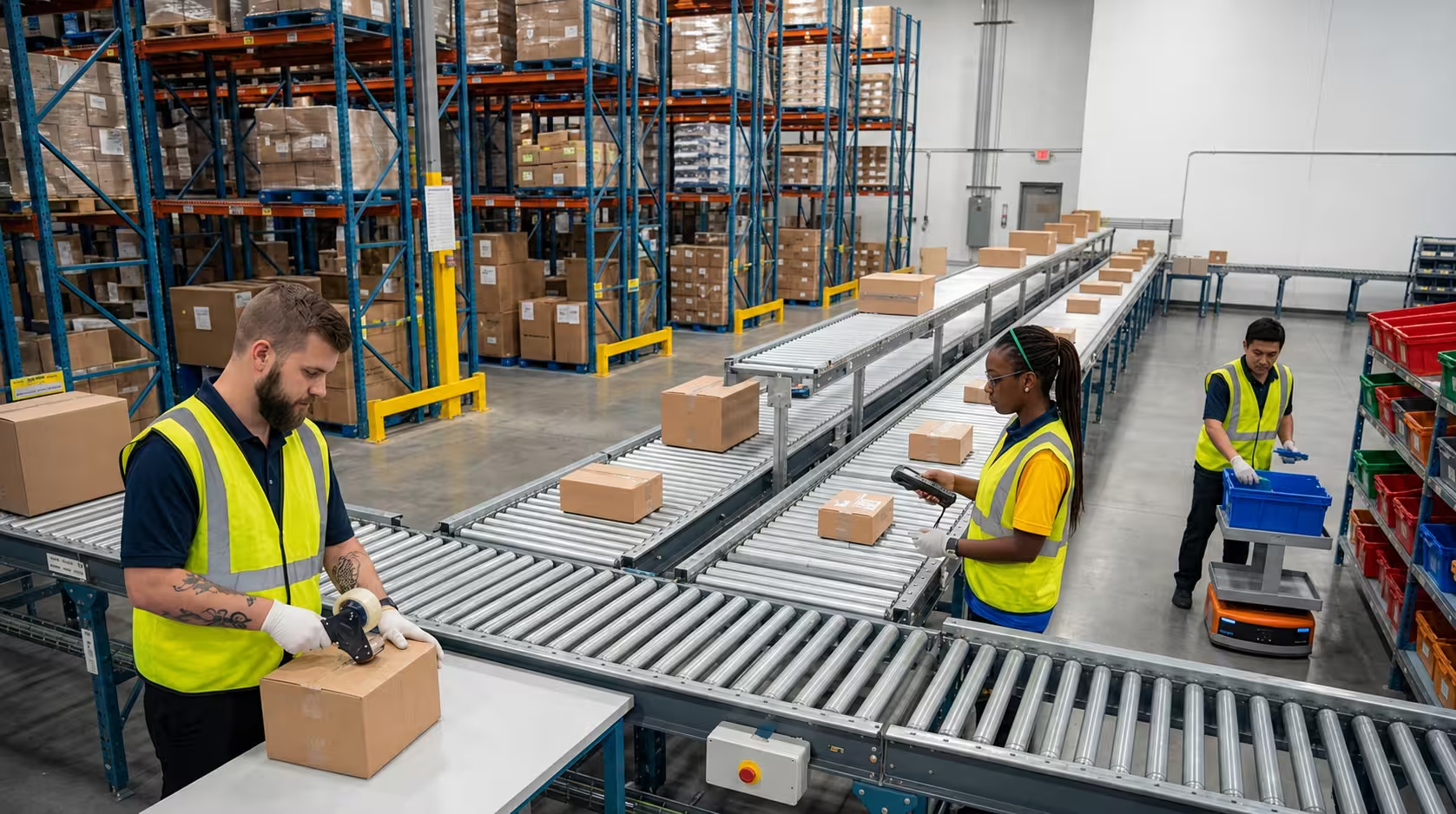
- Inbound: the client ships products into the 3PL's warehouse, where they are received, counted, and logged into a warehouse management system (WMS).
- Orders: sales from the client's storefront or retail channels flow to the 3PL, usually through an integration that syncs orders automatically.
- Fulfillment: staff pick, pack, and label each order, then stage it for shipping.
- Shipping: the 3PL selects carriers and service levels (parcel, LTL, or FTL) to balance speed and cost, often reaching the customer in one to two days.
- Returns: many providers also manage reverse logistics, inspecting, restocking, or disposing of returned items.
Throughout, the 3PL never takes title to the goods. They are paid to move and manage them, not to buy and resell them. That single distinction separates a 3PL from a distributor or a wholesaler.
The Main Types of 3PL Models
Not every provider operates the same way. The clearest way to read the 3PL model is by what the provider actually owns:
Type - Asset-based
What they own: Warehouses, trucks, and equipment
Best suited to: Clients who want one accountable operator running everything
Type - Non-asset-based
What they own: No physical assets; they broker capacity
Best suited to: Flexible, scalable freight and transportation needs
Type - Asset-light
What they own: A few strategic assets, mostly brokered
Best suited to: Brands wanting a balance of control and flexibility
Providers also differ by scope: a full-service 3PL bundles warehousing, transportation, and distribution, while a specialist focuses on one function such as freight brokerage or e-commerce fulfillment. Many freight brokers are themselves non-asset 3PLs, arranging carrier capacity they do not own.
Asset-based is not automatically "better" than non-asset. Non-asset providers can pivot faster and cover lanes an owned fleet cannot, while asset-based 3PLs offer tighter control. The right fit depends on the client's freight profile.
How a 3PL Business Makes Money
A 3PL earns across several layers rather than charging one flat fee:
- Warehousing and storage, billed by pallet, cubic foot, or weight for the space inventory occupies.
- Pick and pack and fulfillment, charged per order, unit, or SKU handled.
- Transportation and freight, from either marked-up brokered rates or owned fleet capacity.
- Value-added services such as kitting, labeling, light assembly, and returns, billed per activity.
- Technology and subscriptions: client dashboards, integrations, and minimum monthly commitments.
The economics work through economies of scale: by pooling much volume, a 3PL wins better carrier rates and spreads fixed warehouse costs across far more orders than any single brand could. Those savings are part of the Unique Value Proposition in a 3PL’s messaging
How to Start a 3PL Business
Knowing how to start a 3PL business is less about leasing a warehouse and more about sequencing the right moves:
- Niche: Decide where you add value: e-commerce fulfillment, cold chain, bonded warehousing, or freight brokerage? Don’t try to serve everyone. It won’t work.
- Funding: Map your costs and financing; the U.S. Small Business Administration outlines routes from self-funding to SBA-backed loans.
- Licensing: Register your entity and, if you will be moving freight across state lines, secure operating authority and a USDOT number through the FMCSA.
- Technology: Choose a capable WMS; ideally one that separates clients and offers a customer-facing portal.
- Clients: Demand is real. U.S. retail e-commerce alone reached $326.7 billion in a single quarter of 2026. The hard part is getting found in AI search and traditional search by the shippers looking for what you offer. This is where SEO for logistics companies and logistics-specific content start to matter.
As you see, the operational setup is solvable with capital and planning. The harder, ongoing challenge is consistent client acquisition. Spiral can help you with that.
Wondering if an agency beats building an in-house team? See how Spiral compares.
Turn 3PL Capacity Into Booked Shipper Deals
Warehouse space does not fill itself. The shippers who need you are searching Google right now. The only question is whether they will find you or a competitor.
Spiral works exclusively with freight brokers, 3PLs, carriers, and warehousing companies, turning search visibility into qualified shipper leads, backed by targeted outbound initiatives to verified shippers. Let’s talk about how our logistics marketing strategy can ignite your sales pipeline.
Ready to fill your pipeline?
Talk to Spiral about logistics marketing that converts.
Frequently Asked Questions
What is the difference between a 3PL and a 4PL?
A 3PL executes logistics (warehousing, fulfillment, and transportation). A 4PL sits above one or more 3PLs, coordinating the whole supply chain strategically without owning the physical infrastructure or running day-to-day operations themselves.
Does a 3PL take ownership of my products?
No. A 3PL stores, handles, and ships your inventory but never takes title to it. You keep ownership throughout, and the provider is paid to manage the goods rather than to buy and resell them.
How is 3PL pricing usually structured?
Pricing is modular, not a single fee. A brand typically pays separate charges for storage, receiving, pick and pack, shipping, and value-added services, scaled to order volume and product profile rather than one flat monthly rate.
How much does it cost to start a 3PL business?
It varies widely with model and scale. An asset-light brokerage can start lean, while an asset-based warehouse operation needs real estate, equipment, technology, insurance, and staffing; often a substantial six-figure investment before the first client signs.
Similar Posts