Learning how to start a 3rd party logistics company is less about owning trucks than about deciding which link in the supply chain you want to own. The good news is that demand is on your side: the U.S. Bureau of Labor Statistics projects logistician roles to grow 18% between 2025 and 2035, far faster than the average occupation, as e-commerce keeps pushing freight volumes higher.
But the operators who last are the ones who pick a clear model, price it correctly, and get the paperwork right before the first load ever moves. This guide walks you through it step by step, from choosing your niche to landing your first paying client.
TL;DR
- Pick your model: freight brokerage, third-party logistics warehousing, asset-based trucking, and last-mile delivery each carry very different startup costs and licensing.
- Costs vary widely, from roughly $12,000-$25,000 for an asset-light brokerage to $100,000 or more for an asset-based fleet.
- Little money works if you launch a non-asset model, bootstrap, and reinvest your first commissions.
- Legal setup first: Register your entity, get an EIN, and secure the right operating authority and insurance before you move or broker a load.
- Stay findable. A discoverable brand is where logistics-specific marketing does the quiet selling.
Choose Your Logistics Model First
Logistics is the coordination of moving and storing goods, but "a logistics company" can mean five very different businesses. Before you register anything, decide which one you are building, because the model dictates your capital, your licenses, and your buyer.
Freight brokerage
- What you do: Match shippers with carriers for a margin
- Startup cost: Low - $12K–$25K
- Assets required: None
3PL / warehousing
- What you do: Store, pick, pack, and ship for clients
- Startup cost: High - $50K–$500K+
- Assets required: Warehouse, WMS, pickers
Asset-based trucking
- What you do: Own and operate your own trucks
- Startup cost: High - $100K+
- Assets required: Trucks, drivers
Last-mile / courier
- What you do: Handle local final-mile delivery
- Startup cost: Low–Medium - $10K–$40K
- Assets required: Vans or contractors
Freight forwarding
- What you do: Coordinate international shipping and customs
- Startup cost: Medium - $20K–$60K
- Assets required: Bonds, licenses
A freight brokerage is the classic low-overhead entry point. It thrives on relationships and rate negotiation rather than owned equipment. An asset-based carrier, by contrast, is a capital business from day one. The model you choose sets:
- your cost floor,
- your compliance burden,
- whether you're selling capacity or coordination.
Starting a Third-Party Logistics (3PL) Company
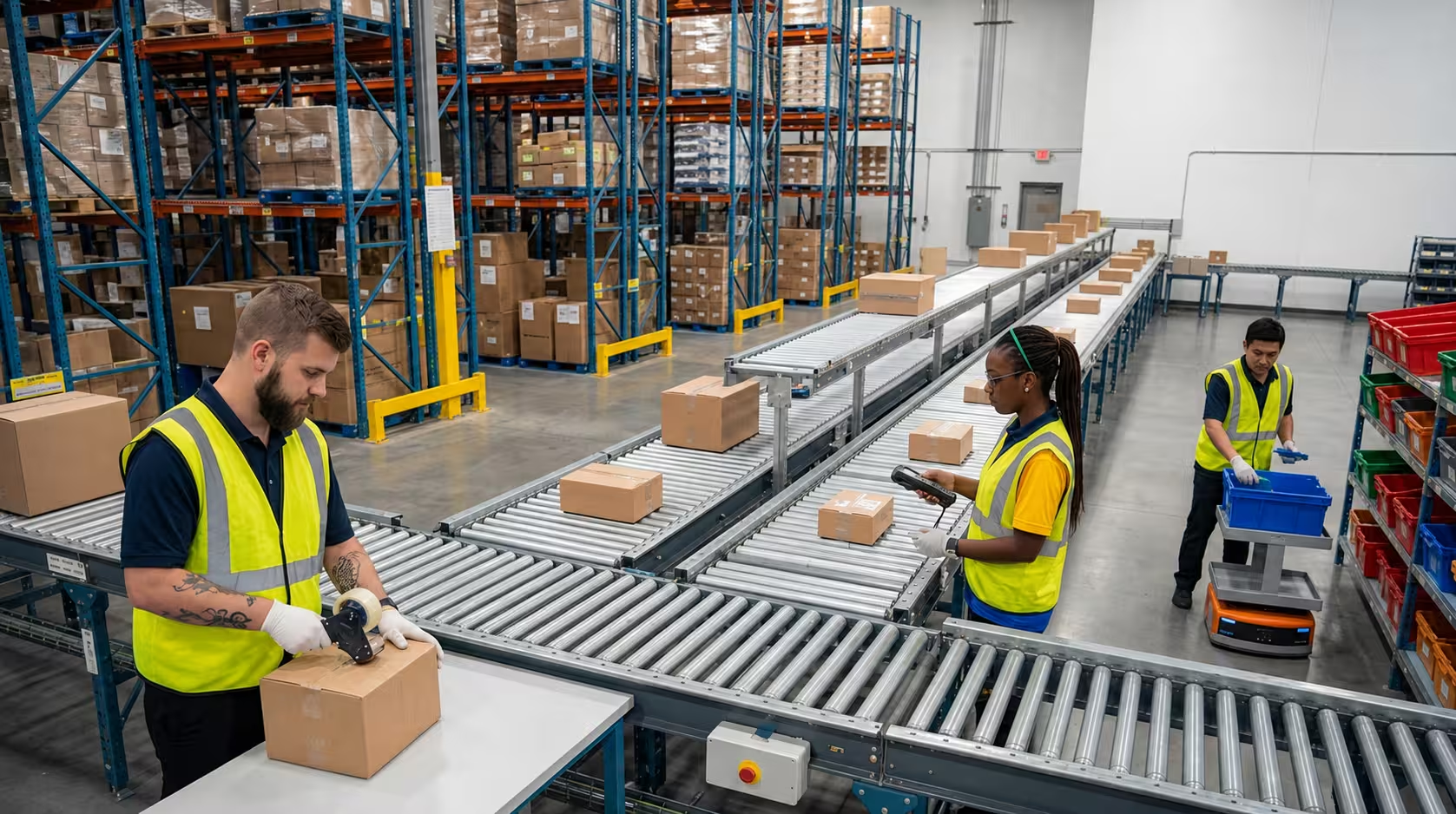
If you want to store and fulfill inventory for other brands, you're building a third-party logistics (3PL) company, not a carrier. It needs warehouse space, a warehouse management system (WMS), and dependable labor for pick, pack, and ship.
✅ The upside is stickier, higher-margin contracts.
❌ The trade-off is heavier upfront investment.
How to Start a Logistics Company Step by Step
Once your model is set, the launch sequence is broadly the same whether you're brokering freight or opening a fulfillment center.
- Business plan. Map your niche, target shippers, pricing, and first-year cash flow. The SBA's business plan framework is a solid structure.
- Register the entity. Most new operators form an LLC for liability protection; the SBA outlines each business structure. Then register with your state and get an EIN from the IRS for taxes and hiring.
- Operating authority. Carriers and brokers register through the FMCSA for a USDOT number and operating authority (an MC number). Requirements vary by state and by whether you cross state lines.
- Insurance. Expect general liability plus cargo coverage; carriers add auto liability, and brokers carry a surety bond. Underwriters will want proof before you activate your authority.
- Location and technology. Start lean; a home office suits a brokerage, while a 3PL needs warehouse space near ports, rail, or population centers. Add a TMS or WMS to run shipments without spreadsheets.
- Pricing. Build rates that cover payroll, fuel, tolls, insurance, and software with margin left over. Since carriers often wait 30-60 days to get paid, budget for factoring or a working-capital buffer.
- First clients. Lean on your network first, then build a repeatable pipeline. Spiral's playbook on generating leads in logistics shows what actually fills a pipeline.
📌 Note: brokers and carriers are regulated differently. A freight broker needs operating authority and a BMC-84 surety bond but no trucks; an asset-based carrier needs a USDOT number, vehicle insurance, and drivers who meet federal hours-of-service rules.
How Much Does It Cost to Start a Logistics Company?
The honest answer to how much a logistics company costs to start depends entirely on the model. An asset-light freight brokerage is the cheapest legitimate on-ramp. Here's a realistic first-year budget for one.
Estimated year-one total ~$12,000–$25,000
Add trucks and the number jumps past $100,000 fast; add a warehouse lease and a WMS and a 3PL can run well into six figures. That's why so many founders start with coordination rather than assets and buy equipment only once contracts justify it.
How to Start a Third-Party Logistics Company Without Money
Starting a logistics company without money is possible, but only if you pick a model that doesn't require assets. The path most first-time founders take is the non-asset brokerage or agent route, where your product is relationships and rate expertise rather than a fleet. You can launch as an agent under an established brokerage's authority, earning commission while you learn the desk and build a book of business, then spin out on your own authority once the revenue is steady.
From there, keep overhead near zero:
- remote work,
- free software trials,
- no early hires.
Reinvest those first commissions into insurance, tools, and marketing. A focused small logistics company that owns one lane, one region, or one commodity (reefer, hazmat, or final-mile medical) can win business where generalists can't. When you're ready to scale into equipment or a lease, the SBA outlines loan and funding options built for exactly that step.
Get Found by the Shippers Already Searching for You
Launching the company is only the first half. The second half is making sure the shippers, brokers, and manufacturers searching for your service find you instead of a competitor. That's a different discipline built on logistics SEO, content that speaks your buyer's language, and outbound that keeps the pipeline full.
The logistics industry is the only industry Spiral works in. Our strategy starts from what already works in freight and fulfillment rather than from scratch. Book a free call and check out real results.
Frequently Asked Questions
How long does it take to start a logistics company?
A non-asset brokerage can be operational in four to eight weeks, mostly limited by FMCSA authority processing and bond approval. An asset-based carrier or 3PL with equipment, a lease, and hiring typically takes three to six months.
Do I need a USDOT number and an MC number?
It depends on your role. Interstate carriers need a USDOT number, and both carriers and brokers operating across state lines need operating authority (an MC number) from the FMCSA. Intrastate-only rules vary by state, so check locally.
What is the easiest logistics business to start?
Freight brokerage is usually the easiest and cheapest, because it needs no trucks or warehouse; only operating authority, a surety bond, insurance, and strong shipper and carrier relationships. It rewards sales skill over capital.
How much does it cost to start a 3PL logistics company?
A small third-party logistics operation with a modest warehouse lease, racking, a WMS, and initial labor commonly runs $75,000-$250,000 in the first year, depending on square footage and location.
Is a small logistics company profitable?
It can be. Freight brokerages often run on healthy gross margins per load, and niche carriers command premium rates. Profitability hinges on disciplined pricing, tight cash-flow management, and a steady flow of clients who trust you.
Similar Posts